Rolex Day Date Puzzle Dial Details and Replica Comparison Points
The colourful Rolex Day-Date 36 introduced in 2023 is one of the least conventional designs in the collection. Instead of using the day and date displays in the usual way, Rolex turned both apertures into part of the dial’s visual theme. That makes the watch especially useful for replica comparison because there are many small elements that need to work together before the design looks convincing.
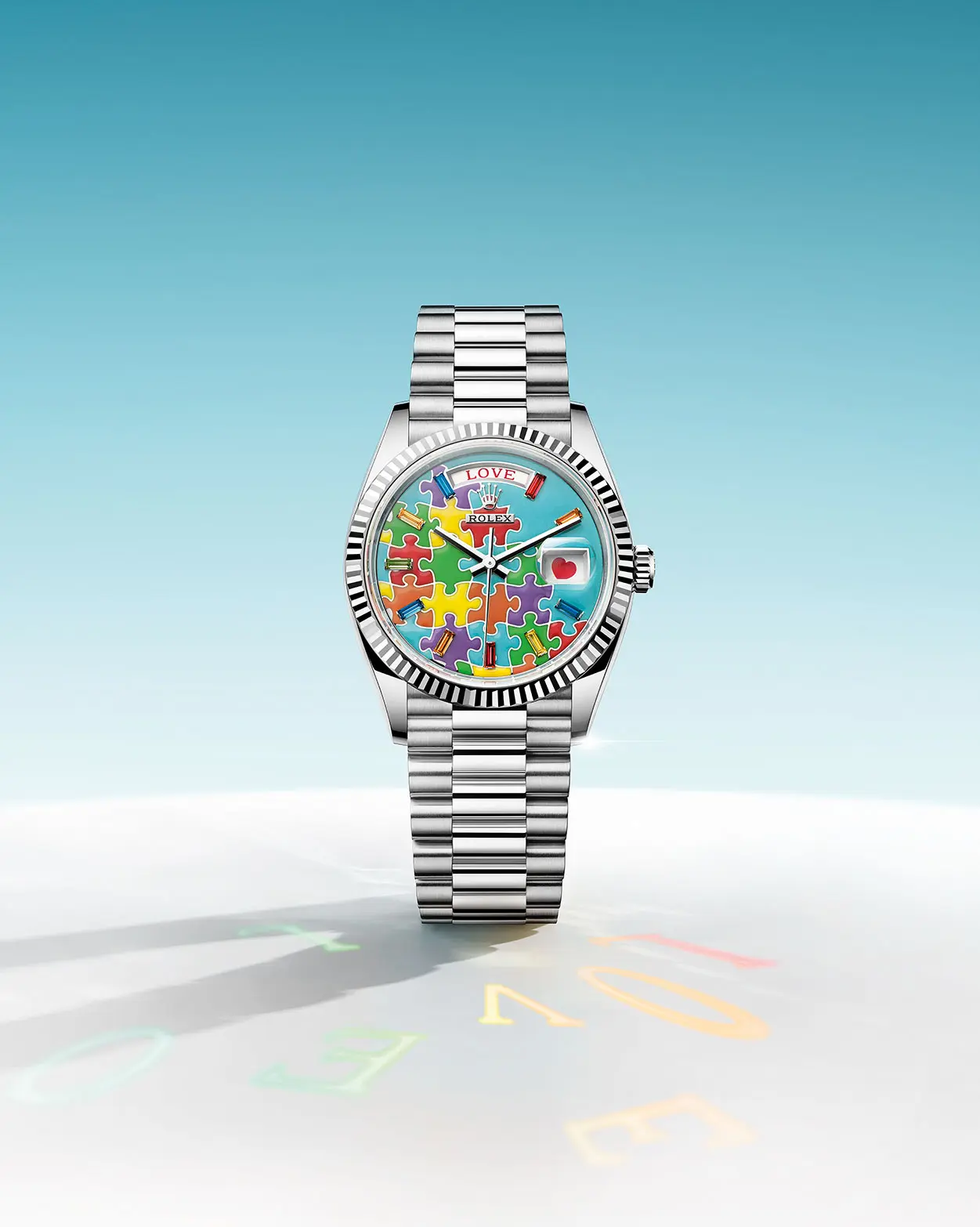
On the genuine watch, the day window at 12 o’clock cycles through inspirational words including Love, Peace and Hope. The window at 3 o’clock replaces the date with a sequence of 31 emojis. Rolex also used a multicolour puzzle motif produced with champlevé enamelling, together with rainbow-coloured baguette-cut sapphire hour markers. These details belong to the genuine Day-Date 36 and should be treated as the reference point rather than as assumed specifications for a replica.
Why this dial is difficult to reproduce
A conventional Day-Date dial has strong visual symmetry, but the Puzzle version introduces many more colours, shapes and surfaces. That means a replica can look busy very quickly if the palette is too saturated or the puzzle sections are poorly defined. The most useful comparison is not whether the watch looks “colourful enough”, but whether the individual elements retain the spacing and balance of the original.
For a Rolex Day Date Puzzle dial replica, check the size and position of the two calendar apertures first. The word display at 12 o’clock needs to sit cleanly within the dial layout, while the emoji window at 3 o’clock should align naturally with the surrounding motif. Poor typography, an oversized aperture or an incorrectly centred disc can be more obvious than a small colour difference.
The baguette hour markers are another useful test. Their colours should complement the dial rather than disappear into it, and the setting should remain neat around the highly patterned background. The coronet, minute track and hands also need enough contrast to stay legible. These are the kinds of Day Date dial details that reveal proportion errors even when a photograph looks impressive at first glance.
Case and bracelet still matter
The unusual dial attracts most of the attention, but the watch still needs to look like a Day-Date. Case shape, fluted bezel proportions and the President-style bracelet provide the familiar framework around the experimental dial. On a replica, overly thick bracelet links or a bezel with the wrong depth can change the balance of the watch before the dial is even considered.
Readers browsing the Rolex Day Date replica section will find that these proportions matter across the whole collection. The Puzzle design simply makes inconsistencies easier to spot because the visual language is already so complex.
Movement claims also need restraint. The external design can be compared from photographs and measurements, but the movement inside a replica may vary substantially between versions. A decorated rotor or familiar engraving does not establish that a replica uses the same calibre, materials, accuracy standard or power reserve as a genuine Rolex.
That distinction is important because older replica descriptions often treated genuine Rolex specifications as if they automatically applied to a copy. They do not. A more reliable editorial approach is to state the original specification clearly, then describe only those replica characteristics that can actually be observed or verified.
The Puzzle Day-Date remains interesting because it pushes a very traditional Rolex model into unfamiliar territory. For replica comparisons, however, the useful questions stay practical: dial layout, aperture alignment, marker setting, bezel proportion and bracelet construction. Those details say far more than labels such as “perfect”, “best” or “1:1”.
Across Watch Our Watches, the goal is to keep genuine Rolex reference information separate from discussion of replica interpretations so that readers can see exactly what is known and what still needs verification.